
Write the storyboard.The agent films it.
One workbench for multi-scene AI video: a flat storyboard, one video track, and an agent that writes scenes, draws them, films them and renders the result - showing you the bill before it spends anything.

Short clips are the easy part
Any model will give you five seconds. The work is everything around it - breaking an idea into scenes, keeping one face across all of them, drawing each shot, filming it, trimming it, and merging the result. The video editor is that whole workflow on one screen, and an agent can drive every part of it.
Two kinds of scene, one row shape
Every scene is one image and one video. The only structural choice is what that image is a picture of, and you make it when you create the scene.
Single scene
One frame, one clip, one moment. The script is a line or two, the image is generated from it, and the clip is filmed from the image.
Multi-shot scene
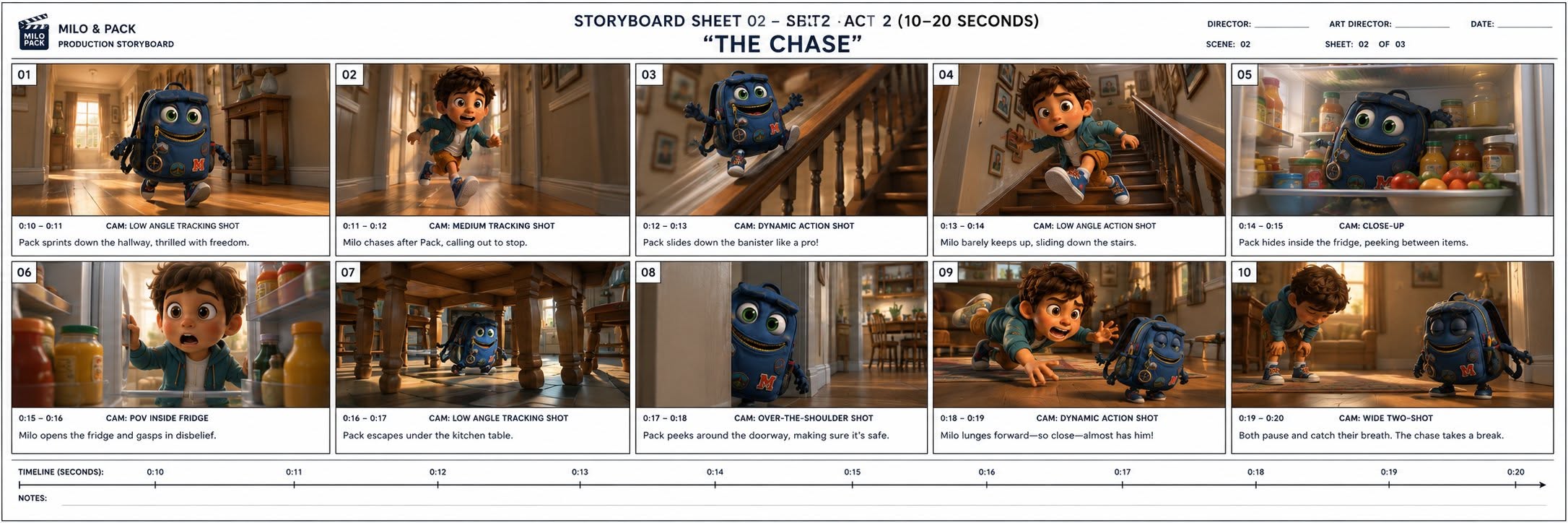
One storyboard sheet holding 2 to 12 numbered shots, the way a storyboard artist draws one, filmed as a single continuous clip by a reference-to-video model.
A six-shot scene costs one image call and one video call instead of six and six. Nothing is cut afterwards: the shots live inside the picture, and the sheet is shown whole in the row and in Properties.
Everything on one surface
No tab split, no second place to press generate. The storyboard is the canvas and the rail follows whatever you select.
The workbench
One flat list
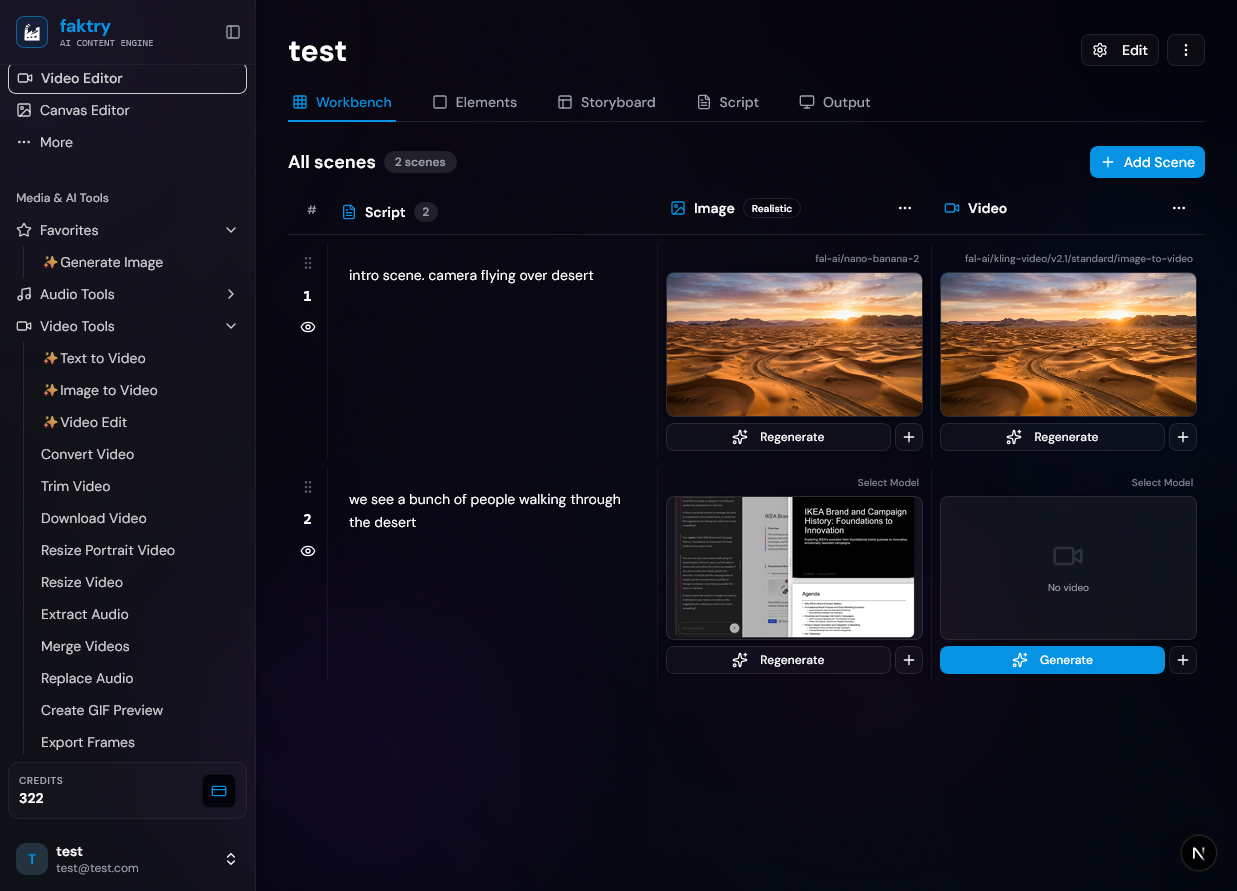
One row per scene, in order. Drag to reorder, hover between rows for an insert point, and generate from the row itself - the status column is the only place generation is offered, and it is identical for both kinds of scene.
One video track
One clip per scene on a single track with a real ruler. Hover a clip to preview it, drag its trim handles, and render the track into one file. Versions are found in the project folder, so a render made anywhere shows up.
A rail, not an overlay
Agent, Elements and Properties share one collapsible column beside the canvas. Selecting a scene switches it to Properties. Expanding narrows the canvas rather than covering it.
Overview and PDF
The whole storyboard in one scrollable view - every scene with its image, its script and its models. Export it as a PDF storyboard for a client, a team or an approval round.
Production control
Elements that hold a face
Type @ in a script to reference a character, product or location. An element is usually a character sheet - front, three-quarter, side and back - and the whole sheet is sent with every generation that scene takes part in.
The prompt you actually send
Image and Video both show the composed prompt, marked Generated. Edit it and it becomes Overridden and is used verbatim. Reset goes back; Rebuild recomposes from the current script, look and elements.
It tells you when it is out of date
Rewrite a script or change a shot count after the image was made and the row shows Changed since drawn, with the header counting them. Nothing redraws by itself, because a redraw costs credits.
Bring your own footage
Any scene can take an uploaded image or clip instead of a generated one, and an end frame where the model films between two stills. Mix real product shots with generated scenes in one storyboard.
An agent that uses the same editor you do
Describe the video and it writes the storyboard with you. It runs the same operations the buttons run, so anything it does you could have done by hand - and it appears on screen the same way.
What it can do
Read the project
It sees the storyboard, the models and what is already generated, exactly as the screen shows it.
Write the storyboard
A whole storyboard in one go, or add, update, split, reorder and delete scenes one at a time.
Draw and film
Generate a scene's image, then film its clip - single frames and multi-shot sheets alike.
Attach and render
Attach an element to a scene as a reference, and render the finished track into one file.
It asks which approach first
Before it writes anything it asks whether you want a few longer multi-shot scenes or one shot per scene, because that decides the shape of everything else. It asks its other questions in the same breath, once, and never asks about what it can already see.
Nothing is spent without a bill
Before the agent spends more than a credit it stops and shows you the cost. Generate missing works the same way: you see the line items and the total before it runs. Approve spending for this project answers the question automatically from then on.
Pick a model per scene
Image and video models are set per project and can be overridden on any single scene. Multi-shot sheets are filmed by reference-to-video models, which read the whole sheet.
Image models
Draw a scene's frame or its storyboard sheet
What people build with it
Multi-scene work where the same face, product or place has to survive from the first shot to the last.
Ads and brand films
16:9 spots and corporate pieces where the product and the presenter have to look the same in every shot, and a client signs off on the storyboard before anything is filmed.
Creator and UGC series
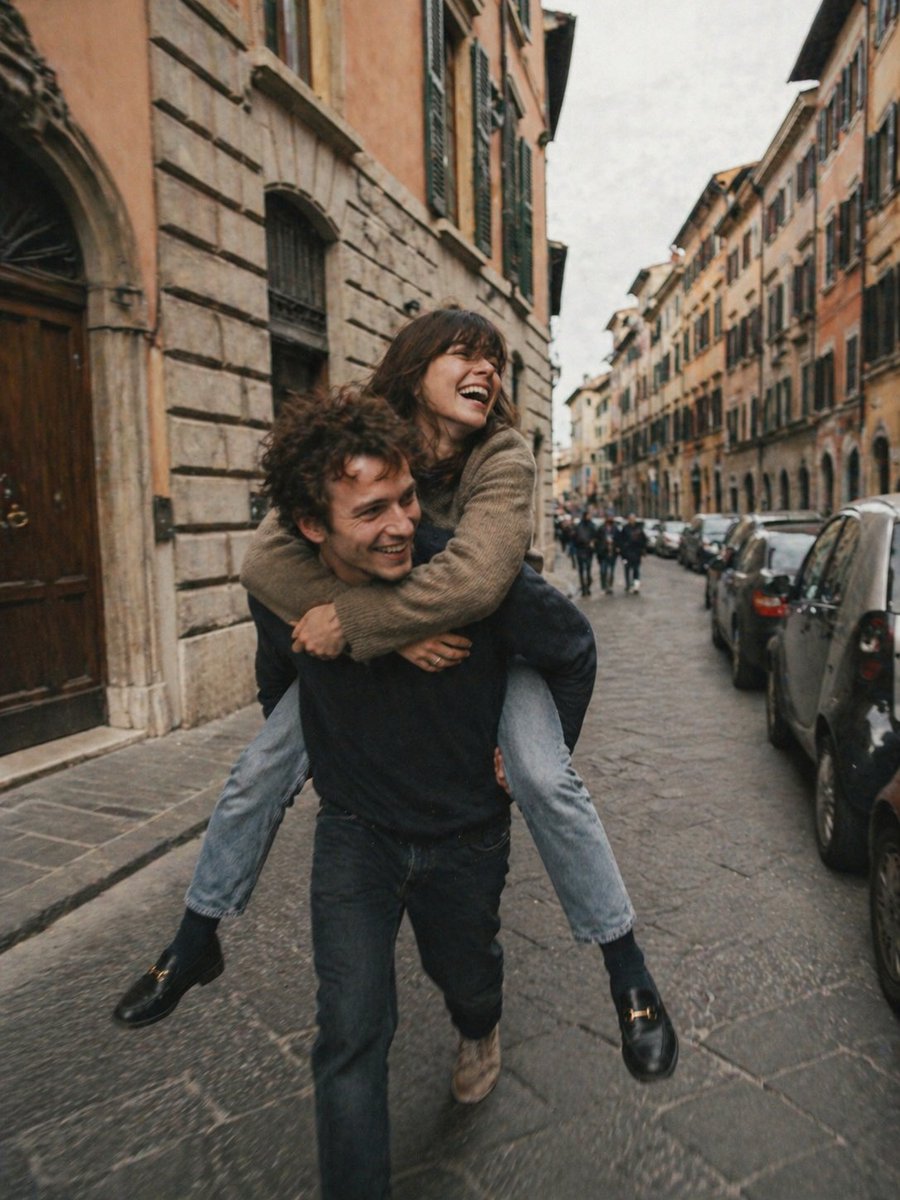
9:16 content for TikTok, Reels and Shorts, where one character sheet keeps the same face across every episode rather than a new person each time.
Product launches
Upload the real product photography for the shots that must be exact, and generate the atmosphere around it. Both live in the same storyboard and the same render.
Explainers and courses
A run of continuous action - a process, a walkthrough, a demonstration - drawn as one storyboard sheet and filmed as one continuous clip rather than six disconnected ones.
Pitch and pre-visualisation
Get the whole storyboard drawn and reviewed as a PDF before committing credits to video. The images are cheap; the clips are where the spend is.
An agent-built first cut
Describe the video, answer one question about the approach, and let the agent write the scenes, draw them and film them. Then take over the rows you want to change.
Capabilities at a glance
What the workbench does, without the marketing words around it.
Scene
- Single or multi-shot
- 2 to 12 shots per sheet
- Per-scene duration
- Exclude from render
Generation
- Image then video, per scene
- Reference-to-video for sheets
- Upload your own image or clip
- End frame where supported
Agent
- Writes the whole storyboard
- Draws and films scenes
- Attaches elements
- Renders the final video
Output
- One clip per scene
- Trim on the track
- Merge and render
- PDF storyboard export
Ready to build your first storyboard?
Start free, and only pay for the images and clips you actually generate.
What you get
Frequently asked questions
How is this different from generating a clip with Veo or Sora?
Generating a clip gives you five to ten seconds from one prompt. The video editor is the production around that: an idea becomes a storyboard of scenes, each scene gets its own image and its own clip, elements keep the same character across all of them, and the track merges into one file. You can still pick Veo, Sora, Kling or Seedance - they are the models doing the filming. What is added is the storyboard, the consistency and the assembly.
What is a multi-shot scene, and when should I use one?
A multi-shot scene is one storyboard sheet holding 2 to 12 numbered shots, filmed as a single continuous clip by a reference-to-video model. Use it for a run of continuous action - a process, a walkthrough, a sequence that belongs together - because the shots hold their look and a six-shot scene costs one image call and one video call instead of six and six. Use single scenes for unrelated moments, where each one wants its own model, prompt and length.
How does character consistency work?
You define characters, products and locations as elements, then reference one by typing @ in a scene's script. The element's image is sent with every generation that scene takes part in. An element is usually a character sheet rather than a single frame - one image holding front, three-quarter, side and back views - because that is what actually keeps a face the same between shots, and the whole sheet is passed to the model.
Does the agent spend my credits without asking?
No. Before it spends more than a credit it stops and shows you what it is about to run and what it costs, and nothing happens until you answer. If you would rather not be asked every time, Approve spending for this project turns that into a standing answer for that project only. Generate missing behaves the same way: line items and a total first, then your confirmation.
Can I mix real footage with AI scenes?
Yes. Any scene can take an uploaded image or video clip instead of a generated one, and where the video model supports it you can also give a scene an end frame so it films between two stills. Uploaded and generated scenes sit in the same storyboard, on the same track, and go into the same render.
What happens if I rewrite a script after the image is made?
The row shows an amber Changed since drawn badge and the storyboard header counts how many scenes are in that state. Nothing redraws by itself, because a redraw costs credits and that should be your decision. The same applies to changing a multi-shot scene's shot count, which changes the grid the sheet is drawn to.
Can I export a storyboard for client review?
Yes. Overview shows the whole storyboard in one scrollable view - every scene with its image, its script and its models - and Export PDF writes it out as a storyboard document. It is built for the approval round: draw the images, get sign-off on the board, and only then spend credits on filming.
What aspect ratios are supported?
Landscape 16:9 for ads, corporate video and YouTube; portrait 9:16 for TikTok, Reels and Shorts; and square 1:1. You pick the format when you create the project and it fixes the shape every image and clip is drawn to, including the layout of a multi-shot storyboard sheet.
Explore more features
Other tools in the faktry suite
AI video generation
Single clips from text or images with Veo, Kling, Sora and Seedance.
Node workflows
Visual pipelines that batch AI models and media operations.
AI agent
The same agent across the app, driving the real tools.
Content library
Every generated and uploaded asset in one organised place.
Image generation
Generate and edit images with the newest image models.